
GCC vs Outsourcing vs BPO: Cost, Control, Knowledge (2026)
4 min read


How is a GCC different from outsourcing?
Outsourcing rents capacity: a vendor's employees do your work under a contract, and the vendor's margin, management, and institutional knowledge sit between you and the output. A Global Capability Center (GCC) owns capability: the people are your employees, the IP is assigned to you, and the accumulated knowledge stays when contracts would have rotated. On cost, stabilized mid-market GCCs run 30 to 40 percent below equivalent outsourced contracts, largely because the vendor margin disappears.
The same distinction covers BPO (business process outsourcing), which is outsourcing applied to business processes. A GCC can house the same processes; the difference remains who employs the people and who keeps what they learn.
GCC vs outsourcing across five dimensions
Dimension | GCC | Outsourcing | Usually favors |
Cost | Your own operating cost, no vendor margin | Vendor margin, sales cost and bench built into the price | GCC above roughly 25 people; outsourcing below |
Knowledge | Compounds inside your company | Exits at each contract rotation or staffing change | GCC |
IP and control | Accrues to you by employment | Deliverable IP by contract; process knowledge is harder to recover | GCC |
Flexibility | Scaling down is a workforce action under local law | Scaling down is a contract negotiation | Outsourcing |
Management load | You run a company | You manage a contract | Outsourcing |
Cost
Outsourcing prices include the vendor's margin, sales cost, and bench. A GCC replaces that stack with your own operating cost, which is why the 30 to 40 percent gap survives even honest accounting of GCC overhead. Outsourcing wins on cost only at small scale, where GCC fixed costs (entity, leadership, compliance) overwhelm the arbitrage below roughly 25 people.
Knowledge
Knowledge is usually the deciding dimension. Every year of vendor work builds understanding of your systems and edge cases inside someone else's company, and it exits at every contract rotation and every vendor staffing change. You then pay for the same learning curve again. A GCC compounds that knowledge on your side of the ledger, so you pay for the learning curve once.
IP and control
Vendor contracts assign deliverable IP, but process knowledge, tooling improvements, and architectural judgment are harder to claw back. In a GCC these accrue to you by employment, not by clause.
Flexibility
Flexibility is outsourcing's genuine advantage. Scaling a vendor contract down is a negotiation; scaling a GCC down is a workforce action in a jurisdiction you must respect. Companies with lumpy, uncertain demand should keep a vendor layer for exactly this reason.
Management load
Outsourcing lets you manage a contract; a GCC requires you to manage a company. That is a real cost, and pretending otherwise is how centers end up run from HQ instead of owning outcomes. BCG's 2025 survey of GCC and enterprise leaders found only 8 percent of GCCs had advanced significantly across innovation, competitive differentiation, and operational efficiency.
The rent-or-own test: which functions belong in a GCC
Take your three most important outsourced functions. For each, ask: if the people doing this work vanished tomorrow, would we lose something we cannot buy back? Where the answer is no, keep the vendor; commodity work is what vendors are genuinely better at. Where the answer is yes, you are paying ownership prices without receiving, and that function is a candidate for a GCC.
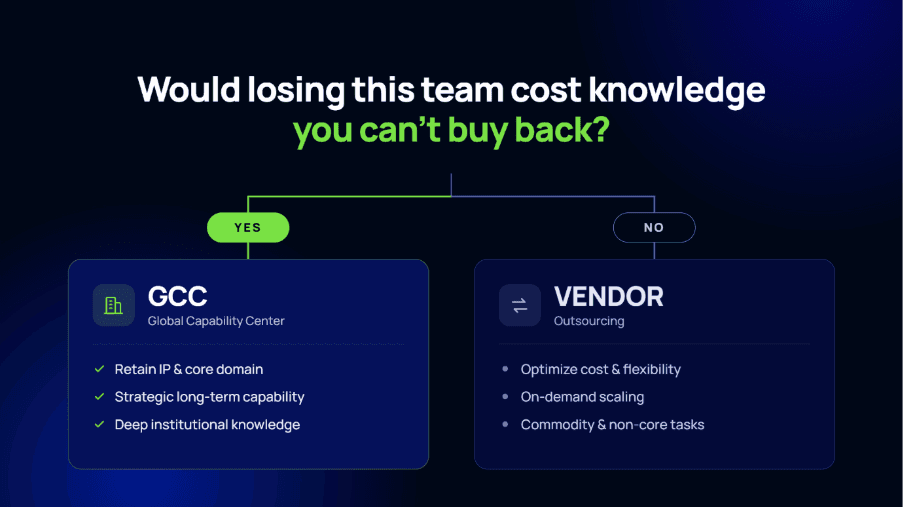
Most mid-market companies land on a hybrid: core, knowledge-compounding functions in a GCC, commodity and spike capacity with vendors. The two models answer different questions, and the answer can change from one function to the next.
Run the rent-or-own test on your outsourced functions
Bring your current outsourcing contracts. Enablr's team will work through which functions are worth owning in a GCC and which should stay with your vendors.
<section class="faq-section"> <div class="faq-inner"> <div class="faq-side fi v"> <div class="eyebrow">FAQs</div> <h2 class="sh2">Frequently asked questions</h2> <p class="sp"> Straight answers on how GCCs compare with captive centers, outsourcing and BPO, and how to move from a vendor contract to your own centre. </p> <a href="/contact" class="btn-primary">Talk to Us →</a> </div> <div class="faq-list fi v"> <!-- FAQ 1 --> <div class="faq-item"> <div class="faq-q" onclick="toggleFaq(this)" aria-expanded="false"> <span class="faq-q-text">Is a GCC the same as a captive center?</span> <span class="faq-toggle"> <svg viewBox="0 0 24 24"> <line x1="12" y1="5" x2="12" y2="19"></line> <line x1="5" y1="12" x2="19" y2="12"></line> </svg> </span> </div> <div class="faq-a"> <div class="faq-a-inner"> Yes. Captive center is the older term; the industry moved to GCC as these units shifted from back-office support to owning products, data platforms, and global functions. </div> </div> </div> <!-- FAQ 2 --> <div class="faq-item"> <div class="faq-q" onclick="toggleFaq(this)" aria-expanded="false"> <span class="faq-q-text">Is a GCC cheaper than outsourcing?</span> <span class="faq-toggle"> <svg viewBox="0 0 24 24"> <line x1="12" y1="5" x2="12" y2="19"></line> <line x1="5" y1="12" x2="19" y2="12"></line> </svg> </span> </div> <div class="faq-a"> <div class="faq-a-inner"> Once stable and above roughly 25 people, yes, by 30 to 40 percent. Below that scale, outsourcing or employer-of-record (EOR) structures usually win on total cost. </div> </div> </div> <!-- FAQ 3 --> <div class="faq-item"> <div class="faq-q" onclick="toggleFaq(this)" aria-expanded="false"> <span class="faq-q-text">What is the difference between a GCC and BPO?</span> <span class="faq-toggle"> <svg viewBox="0 0 24 24"> <line x1="12" y1="5" x2="12" y2="19"></line> <line x1="5" y1="12" x2="19" y2="12"></line> </svg> </span> </div> <div class="faq-a"> <div class="faq-a-inner"> BPO is outsourced business-process work performed by a vendor's employees. A GCC performs processes, engineering, or both with your own employees in your own entity. </div> </div> </div> <!-- FAQ 4 --> <div class="faq-item"> <div class="faq-q" onclick="toggleFaq(this)" aria-expanded="false"> <span class="faq-q-text">Can an outsourcing contract be converted into a GCC?</span> <span class="faq-toggle"> <svg viewBox="0 0 24 24"> <line x1="12" y1="5" x2="12" y2="19"></line> <line x1="5" y1="12" x2="19" y2="12"></line> </svg> </span> </div> <div class="faq-a"> <div class="faq-a-inner"> Often, yes. The common routes are a <a href="https://gccenablr.com/engagement-models/build-operate-transfer">build-operate-transfer (BOT)</a>, where a partner builds and runs the center before transferring it to you, or moving selected functions into your own entity as vendor contracts expire, subject to each contract's terms. </div> </div> </div> </div> </div> </section> <style> :root { --faq-ink: #12151c; --faq-body: #5a616f; --faq-line: #e6e8ec; --faq-accent: #4b3df6; --faq-bg: #fbfbfd; } * { box-sizing: border-box; } .faq-section { background: var(--faq-bg); font-family: 'Inter', 'Helvetica Neue', Arial, sans-serif; padding: 80px 24px; } .faq-inner { max-width: 1120px; margin: 0 auto; display: grid; grid-template-columns: 340px 1fr; gap: 64px; align-items: start; } .faq-side { position: sticky; top: 40px; } .eyebrow { font-size: 12px; font-weight: 700; letter-spacing: 1.5px; text-transform: uppercase; color: var(--faq-accent); margin-bottom: 14px; } .sh2 { margin: 0 0 12px; font-size: 32px; line-height: 1.15; letter-spacing: -1px; font-weight: 650; color: var(--faq-ink); } .sp { margin: 0 0 20px; font-size: 14px; line-height: 1.6; color: var(--faq-body); max-width: 38ch; } .btn-primary { display: inline-flex; align-items: center; gap: 6px; background: var(--faq-ink); color: #fff; text-decoration: none; font-size: 14px; font-weight: 600; padding: 12px 22px; border-radius: 999px; transition: background .2s ease, transform .2s ease; } .btn-primary:hover { background: var(--faq-accent); transform: translateY(-1px); } .faq-list { display: flex; flex-direction: column; } .faq-item { border-bottom: 1px solid var(--faq-line); } .faq-item:first-child { border-top: 1px solid var(--faq-line); } .faq-q { display: flex; align-items: center; justify-content: space-between; gap: 24px; padding: 22px 4px; cursor: pointer; user-select: none; } .faq-q-text { font-size: 16px; font-weight: 560; color: var(--faq-ink); line-height: 1.4; transition: color .2s ease; } .faq-q:hover .faq-q-text { color: var(--faq-accent); } .faq-toggle { flex: 0 0 auto; width: 28px; height: 28px; border-radius: 50%; border: 1px solid var(--faq-line); display: flex; align-items: center; justify-content: center; transition: background .25s ease, border-color .25s ease, transform .3s ease; } .faq-toggle svg { width: 14px; height: 14px; stroke: var(--faq-ink); stroke-width: 2; fill: none; transition: stroke .25s ease; } .faq-q[aria-expanded="true"] .faq-toggle { background: var(--faq-ink); border-color: var(--faq-ink); transform: rotate(135deg); } .faq-q[aria-expanded="true"] .faq-toggle svg { stroke: #fff; } .faq-q[aria-expanded="true"] .faq-q-text { color: var(--faq-ink); font-weight: 650; } .faq-a { display: grid; grid-template-rows: 0fr; transition: grid-template-rows .35s ease; } .faq-a-inner { overflow: hidden; font-size: 14.5px; line-height: 1.7; color: var(--faq-body); padding-right: 52px; } .faq-a-inner a { color: var(--faq-accent); font-weight: 600; text-decoration: underline; text-underline-offset: 3px; text-decoration-thickness: 1px; transition: color .2s ease; } .faq-a-inner a:hover { color: var(--faq-ink); } .faq-item.open .faq-a { grid-template-rows: 1fr; } .faq-item.open .faq-a-inner { padding-bottom: 22px; } .fi.v { animation: faqFadeIn .5s ease both; } @keyframes faqFadeIn { from { opacity: 0; transform: translateY(10px); } to { opacity: 1; transform: translateY(0); } } @media (prefers-reduced-motion: reduce) { .faq-a, .faq-toggle, .fi.v { transition: none; animation: none; } } @media (max-width: 900px) { .faq-inner { grid-template-columns: 1fr; gap: 32px; } .faq-side { position: static; } } @media (max-width: 520px) { .faq-section { padding: 56px 18px; } .sh2 { font-size: 26px; } .faq-q-text { font-size: 15px; } .faq-a-inner { padding-right: 0; } } </style> <script> function toggleFaq(qEl) { var item = qEl.closest('.faq-item'); var isOpen = item.classList.contains('open'); document.querySelectorAll('.faq-item.open').forEach(function (openItem) { if (openItem !== item) { openItem.classList.remove('open'); openItem.querySelector('.faq-q').setAttribute('aria-expanded', 'false'); } }); if (isOpen) { item.classList.remove('open'); qEl.setAttribute('aria-expanded', 'false'); } else { item.classList.add('open'); qEl.setAttribute('aria-expanded', 'true'); } } </script>
Ready to build your scalable GCC?
Connect with our experts to discuss how we can help you establish and scale a high-performing Global Capability Center tailored to your business needs.
Recent Insights

GCC Talent in India 2026: Mid-Level, AI and Attrition Gaps
India has 2,117 GCCs and 2.36M professionals, yet GCC talent gaps in mid-level, AI and retention roles persist. See the data and what leaders can do about it.
Oct 9, 2026
4 min read

From Zero to GCC in 90 Days: The 2026 Playbook for Fast, Compliant Setup in India
Learn how enterprises can set up a compliant Global Capability Centre in India within 90 days. A 2026 playbook for leaders for setting up GCCs at speed and scale.
Oct 1, 2026
4 min read

How Long Does It Take to Set Up a GCC in India? Real Timelines
Partner-supported GCC setup reaches go-live in 12 to 24 weeks. Self-managed captives take 12 to 18 months. The stage-by-stage timeline, and why every plan needs a 30 to 40 percent buffer.
Sep 28, 2026
4 min read