
From Zero to GCC in 90 Days: The 2026 Playbook for Fast, Compliant Setup in India
4 min read

Enterprise leaders no longer treat the Global Capability Centre (GCC) as a back-office extension. Forrester observes that companies now value their GCCs as equal collaborators to in-house teams, and many centres have become the main hubs for research and innovation. The most advanced are virtually indistinguishable from offices in the parent geography.
That shift makes speed and scale achievable. Forrester finds it is easier and faster than ever to bring a GCC up to speed, helped by technology talent in India that has matured rapidly since the pandemic. Teams now ask for end-to-end ownership of technology initiatives, which raises the bar for how a centre is designed on day one. The centres that get their structure right early can scale faster and take on more.
The spending data supports moving now. Forrester forecasts that global technology spend will grow 7.8% in 2026 to reach $5.6 trillion. India's expansion of GCCs and AI cloud adoption will push its IT spend growth into double digits, and as demand for talent rises with it, enterprises that wait will pay more for every hire.
Why most GCC setups delay?
Most delays come from decisions that leaders make too late. The regulatory process itself rarely slows a launch.
Many leadership teams debate the purpose of the centre after they sign the lease. They choose a city before they define the talent profile they need. They learn about labour and data obligations only when the first offer letters are ready to go out. Each of these gaps adds weeks to the timeline, and the delays compound.
Forrester warns that GCCs move through boom-and-bust cycles. Loss of focus and neglect from headquarters drive the bust phase. A slow launch invites both problems, because the centre starts without a clear mandate or strong sponsorship from the parent.
A 90-day plan works because it forces the hard decisions to the front of the program. It treats setup as one program with one accountable owner. That single owner keeps every workstream moving toward the same date.
The 90-day playbook
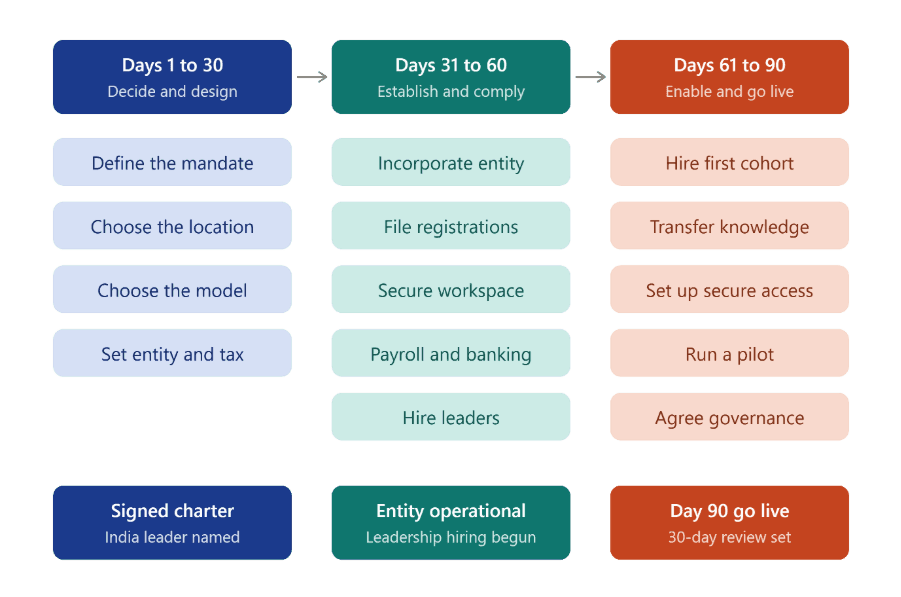
Days 1 to 30: Decide and design
The first month sets the direction. Four decisions matter most.
Define the mandate. State what the centre will own. A clear scope shapes every hiring and location choice that follows.
Choose the location. Match the city to the talent profile you need. Bengaluru offers engineering depth. Other cities offer cost advantages and state incentives. Many enterprises anchor in one deep market and add a second site later.
Select the operating model. A captive entity gives full control. A build-operate-transfer model lets a partner set up and run the centre first, then hand over ownership at a pre-agreed stage. A managed GCC-as-a-service model sits between the two. Choose based on speed and risk appetite.
Design the entity and tax structure. Involve finance and legal now. Transfer pricing and intellectual property ownership are easier to settle before operations begin.
By day 30, the team should hold a signed charter and a named India leader. The location and the model should be final.
Days 31 to 60: Establish and comply
The second month turns the decisions from month one into a legal and physical presence in India. The team incorporates the entity and completes the statutory registrations. It also secures a workspace for the first hires. A managed facility often saves several weeks compared with a custom fit-out. The finance team then sets up payroll and opens the local bank accounts.
Recruitment of the leadership layer begins in this month. Those leaders anchor the culture and shape every hire below them. Talent planning starts at the same time. Strong candidates compare several offers quickly. A clear employer brand and a quick hiring process help the centre win them. This month also carries the compliance work described in the next section.
Days 61 to 90: Enable and go live
The final month focuses on people and readiness. The team hires and onboards the first cohort of employees. Knowledge transfer from the parent organization begins at the same time. The IT team configures secure access and puts the security controls in place. Before full go-live, the centre runs a pilot workstream to test its processes. Leaders then agree on governance and performance metrics with headquarters.
Day 90 marks the start of delivery. The program continues beyond that date. By then, the centre is legally sound and fully staffed, and it has a working relationship with the parent business. The team sets a review 30 days after go-live. That review shows what the early results say, and leaders adjust hiring plans and priorities accordingly.
Compliance in 2026: what has changed?
India has changed its regulatory rulebook in the past year, and every new GCC must plan around the changes. The following areas need attention from day one.
Labour codes. Four labour codes took effect on November 21, 2025. They consolidated 29 central laws into a single framework. Coverage now extends to fixed-term employees and contract workers. A contract label alone no longer decides how the law classifies a worker. GCCs with layered staffing models should review their structures early.
Data protection. The government notified the Digital Personal Data Protection Rules in November 2025. The rules come into force in phases through 2027. A GCC that handles personal data must build consent and governance into its first design. Retrofitting these controls later takes more time and money.
Workplace policy. Since July 2025, companies must disclose POSH complaint data in the Board's Annual Report. Each establishment also needs its own Internal Complaints Committee. A new centre should set up this committee before its first employees join.
State policy. Several states now offer incentives for GCCs. However, incentives come with conditions, so leaders should review those conditions before they commit to a location. Leaders must check for dedicated regulatory framework and tax incentives for the sector.
Compliance built into the plan costs little rather than post launch. From Zero to GCC in 90 Days, Th…
Build the GCC for AI from the first day
Speed means little if the centre is designed for yesterday's work. More than 1,200 GCCs in India have already embedded AI and machine learning. The country has roughly 250,000 AI professionals.
Enterprise readiness lags. Gartner predicts that by 2027, 50% of Enterprises without a people-centric AI strategy will lose their top AI talent.
Four questions to answer in week one
Who owns the program from start to finish?
What will the centre own in year one and in year three?
Which regulatory obligations apply on day one?
How will headquarters and the centre share decisions?
A team that answers these in week one will outpace a team that answers them in month four.
From board decision to a working centre
Enablr helps global enterprises build next-generation GCCs in India. We act as a catalyst. We shorten the distance between a board decision and a working centre.
We bring one integrated program in place of disconnected vendors. One accountable team covers the full journey from strategy to operations. This approach removes the handoffs where most delays begin. Leaders get one point of contact and one plan.
Enablr designs each centre for the mandate it must deliver. We build compliance in from day one. We design for AI-led delivery from the start. We stay through scale, so the centre matures from a capable team into a strategic asset for the parent enterprise.
The 2026 market rewards enterprises that move with clarity. Enablr gives leaders the playbook and the pace to do so. Schedule a call today.
<section class="faq-section"> <div class="faq-inner"> <div class="faq-side fi v"> <div class="eyebrow">FAQs</div> <h2 class="sh2">Frequently asked questions</h2> <p class="sp"> Straight answers on GCC setup timelines, compliance, operating models, and why India. </p> <a href="/contact" class="btn-primary">Talk to Us →</a> </div> <div class="faq-list fi v"> <!-- FAQ 1 --> <div class="faq-item"> <div class="faq-q" onclick="toggleFaq(this)" aria-expanded="false"> <span class="faq-q-text">How long does it take to set up a GCC in India?</span> <span class="faq-toggle"> <svg viewBox="0 0 24 24"> <line x1="12" y1="5" x2="12" y2="19"></line> <line x1="5" y1="12" x2="19" y2="12"></line> </svg> </span> </div> <div class="faq-a"> <div class="faq-a-inner"> A well-planned GCC can become operational in about 90 days. The timeline holds when leadership settles the mandate and the operating model in the first 30 days. The location decision follows soon after. The second month builds the legal and physical presence, and the third month covers hiring and readiness. Most overruns trace back to decisions that leaders made too late. </div> </div> </div> <!-- FAQ 2 --> <div class="faq-item"> <div class="faq-q" onclick="toggleFaq(this)" aria-expanded="false"> <span class="faq-q-text">What are the main compliance requirements for a GCC in India?</span> <span class="faq-toggle"> <svg viewBox="0 0 24 24"> <line x1="12" y1="5" x2="12" y2="19"></line> <line x1="5" y1="12" x2="19" y2="12"></line> </svg> </span> </div> <div class="faq-a"> <div class="faq-a-inner"> A GCC must incorporate its Indian entity and complete the statutory registrations. It must also follow the four labour codes that took effect in November 2025. The Digital Personal Data Protection Rules apply to any centre that handles personal data, and they roll out in phases through 2027. The POSH law requires each establishment to set up an Internal Complaints Committee. Tax and transfer pricing planning matters equally, because intercompany arrangements shape how the centre bills the parent. </div> </div> </div> <!-- FAQ 3 --> <div class="faq-item"> <div class="faq-q" onclick="toggleFaq(this)" aria-expanded="false"> <span class="faq-q-text">What is the difference between a captive GCC and a build-operate-transfer model?</span> <span class="faq-toggle"> <svg viewBox="0 0 24 24"> <line x1="12" y1="5" x2="12" y2="19"></line> <line x1="5" y1="12" x2="19" y2="12"></line> </svg> </span> </div> <div class="faq-a"> <div class="faq-a-inner"> A captive GCC is built, owned and run by the parent from the start. This model gives the parent full control over talent, intellectual property and culture. It also places all setup effort and risk on the parent. In a build-operate-transfer model, a partner sets up and runs the centre for an agreed period. The partner then transfers ownership to the parent at a pre-agreed stage. This model reduces early risk and speeds up the launch. A managed GCC-as-a-service model is a third option, in which a partner continues to run operations on an ongoing basis. </div> </div> </div> <!-- FAQ 4 --> <div class="faq-item"> <div class="faq-q" onclick="toggleFaq(this)" aria-expanded="false"> <span class="faq-q-text">Why are enterprises choosing India for GCCs?</span> <span class="faq-toggle"> <svg viewBox="0 0 24 24"> <line x1="12" y1="5" x2="12" y2="19"></line> <line x1="5" y1="12" x2="19" y2="12"></line> </svg> </span> </div> <div class="faq-a"> <div class="faq-a-inner"> India offers a deep pool of engineering and AI talent, a mature ecosystem and supportive policy. Forrester observes that technology talent in India has matured rapidly since the pandemic. This maturity makes it faster to bring a new GCC up to speed. NASSCOM projects about 2,400 centres and $105 billion in revenue by 2030. </div> </div> </div> </div> </div> </section> <style> :root { --faq-ink: #12151c; --faq-body: #5a616f; --faq-line: #e6e8ec; --faq-accent: #4b3df6; --faq-bg: #fbfbfd; } * { box-sizing: border-box; } .faq-section { background: var(--faq-bg); font-family: 'Inter', 'Helvetica Neue', Arial, sans-serif; padding: 80px 24px; } .faq-inner { max-width: 1120px; margin: 0 auto; display: grid; grid-template-columns: 340px 1fr; gap: 64px; align-items: start; } .faq-side { position: sticky; top: 40px; } .eyebrow { font-size: 12px; font-weight: 700; letter-spacing: 1.5px; text-transform: uppercase; color: var(--faq-accent); margin-bottom: 14px; } .sh2 { margin: 0 0 12px; font-size: 32px; line-height: 1.15; letter-spacing: -1px; font-weight: 650; color: var(--faq-ink); } .sp { margin: 0 0 20px; font-size: 14px; line-height: 1.6; color: var(--faq-body); max-width: 38ch; } .btn-primary { display: inline-flex; align-items: center; gap: 6px; background: var(--faq-ink); color: #fff; text-decoration: none; font-size: 14px; font-weight: 600; padding: 12px 22px; border-radius: 999px; transition: background .2s ease, transform .2s ease; } .btn-primary:hover { background: var(--faq-accent); transform: translateY(-1px); } .faq-list { display: flex; flex-direction: column; } .faq-item { border-bottom: 1px solid var(--faq-line); } .faq-item:first-child { border-top: 1px solid var(--faq-line); } .faq-q { display: flex; align-items: center; justify-content: space-between; gap: 24px; padding: 22px 4px; cursor: pointer; user-select: none; } .faq-q-text { font-size: 16px; font-weight: 560; color: var(--faq-ink); line-height: 1.4; transition: color .2s ease; } .faq-q:hover .faq-q-text { color: var(--faq-accent); } .faq-toggle { flex: 0 0 auto; width: 28px; height: 28px; border-radius: 50%; border: 1px solid var(--faq-line); display: flex; align-items: center; justify-content: center; transition: background .25s ease, border-color .25s ease, transform .3s ease; } .faq-toggle svg { width: 14px; height: 14px; stroke: var(--faq-ink); stroke-width: 2; fill: none; transition: stroke .25s ease; } .faq-q[aria-expanded="true"] .faq-toggle { background: var(--faq-ink); border-color: var(--faq-ink); transform: rotate(135deg); } .faq-q[aria-expanded="true"] .faq-toggle svg { stroke: #fff; } .faq-q[aria-expanded="true"] .faq-q-text { color: var(--faq-ink); font-weight: 650; } .faq-a { display: grid; grid-template-rows: 0fr; transition: grid-template-rows .35s ease; } .faq-a-inner { overflow: hidden; font-size: 14.5px; line-height: 1.7; color: var(--faq-body); padding-right: 52px; } .faq-item.open .faq-a { grid-template-rows: 1fr; } .faq-item.open .faq-a-inner { padding-bottom: 22px; } .fi.v { animation: faqFadeIn .5s ease both; } @keyframes faqFadeIn { from { opacity: 0; transform: translateY(10px); } to { opacity: 1; transform: translateY(0); } } @media (prefers-reduced-motion: reduce) { .faq-a, .faq-toggle, .fi.v { transition: none; animation: none; } } @media (max-width: 900px) { .faq-inner { grid-template-columns: 1fr; gap: 32px; } .faq-side { position: static; } } @media (max-width: 520px) { .faq-section { padding: 56px 18px; } .sh2 { font-size: 26px; } .faq-q-text { font-size: 15px; } .faq-a-inner { padding-right: 0; } } </style> <script> function toggleFaq(qEl) { var item = qEl.closest('.faq-item'); var isOpen = item.classList.contains('open'); document.querySelectorAll('.faq-item.open').forEach(function (openItem) { if (openItem !== item) { openItem.classList.remove('open'); openItem.querySelector('.faq-q').setAttribute('aria-expanded', 'false'); } }); if (isOpen) { item.classList.remove('open'); qEl.setAttribute('aria-expanded', 'false'); } else { item.classList.add('open'); qEl.setAttribute('aria-expanded', 'true'); } } </script>
Ready to build your scalable GCC?
Connect with our experts to discuss how we can help you establish and scale a high-performing Global Capability Center tailored to your business needs.
Recent Insights

How Long Does It Take to Set Up a GCC in India? Real Timelines
Partner-supported GCC setup reaches go-live in 12 to 24 weeks. Self-managed captives take 12 to 18 months. The stage-by-stage timeline, and why every plan needs a 30 to 40 percent buffer.
Sep 28, 2026
4 min read

BOT vs Captive vs Managed GCC: How to Choose (2026)
Captive for control from day one, BOT for de-risked entry with ownership at month 18 to 36, managed GCC for capability without operating load. The decision rule, by function and hold period. C
Sep 28, 2026
4 min read

GCC-as-a-Service: How Mid-Market Enterprises Build GCCs in 2026
GCC-as-a-Service is helping mid-market enterprises launch fully operational GCCs faster, without the capital and compliance burden legacy models required. See how the model works.
Sep 25, 2026
4 min read