Beyond Cost Savings: How to Build Your GCC Setup ROI Calculator
4 min read

For a long time, the board-level conversation regarding Global Capability Centres (GCCs) followed a predictable, arithmetic rhythm, which was Cost of Talent (A) - Cost of Infrastructure (B) = Arbitrage (C). However, with the expanding GCC and GBS market in India, the conversation has inclined towards innovation and driving growth by building a second HQ through their GCCs.
This disrupts the previously defined equation of gaining profitability from GCCs.
In this present economic landscape and the shifting requirements, an incomplete financial equation brings in a significant liability. GCC ROI calculators that prioritize savings as the primary output manage a mere rounding error on the balance sheet rather than a strategic asset.
Modern GCCs have transitioned from cost reduction to achieving previously impossible outcomes. The actual return on investment resides in the delta between delegated execution and strategic ownership. Leadership must shift toward a value-centre framework to capture this evolution.
The Geometry of Modern ROI
Traditional ROI models are linear, focusing strictly on headcount and real estate. A future-ready GCC requires a calculator that moves beyond the cost-effective phase to account for three distinct value tiers.

Tier 1: Efficiency ROI
Efficiency remains the foundation through labour arbitrage, vendor rationalization, and operational consolidation. These hard savings are increasingly offset by rising talent costs in Tier-1 cities. Going forward, efficiency focuses on cost-per-outcome rather than the lowest cost-per-FTE.
Tier 2: Effectiveness ROI
Effectiveness ROI focuses on Time-to-Market (TTM). In a competitive landscape, the ability to deploy capital and talent faster than the market average is a measurable gain, financially.
Product Velocity
When a GCC progresses from mere staff augmentation to product ownership, it eliminates the friction of hand-offs.
The Mechanism: The GCC removes the bottleneck at HQ by owning the complete DevOps lifecycle. This ownership spans initial architecture and coding through automated testing and deployment. Decentralizing these functions eliminates the traditional dependency on the HQ for execution.
The Quantitative Metric: This is measured by Deployment Frequency and Mean Time to Recovery (MTTR).
The Value: A GCC-led team can reduce the release cycle of a core product from quarterly to bi-weekly. This enables the company to capture market share faster. It also realizes revenue months earlier than its previous baseline.
Follow-the-Sun Agility
This uses geographical distribution as a strategic tool rather than a logistical necessity.
The Mechanism: A 24/7 engineering cycle ensures that work started in the West is picked up by the GCC during the Western dark hours.
The Quantitative Metric: This is measured through roadmap compression. For example, a project requiring 10,000 engineering hours would traditionally span 12 months with a single-region team.
The Value: Distributed teams can execute those hours in 8 months. The 4-month gain recovers the opportunity cost of delay. This reflects the revenue lost when a product remains in development.
Tier 3: Strategic ROI
Strategic ROI measures the GCC’s contribution to the top line.
IP Creation: Local development of patents, proprietary algorithms, and AI models.
Revenue Influence: New revenue streams get unlocked by GCC-led innovations, such as a retail personalization engine that increases global conversion by 4%.
Scaling the Maturity Curve
The Governance Tax, which is the hidden cost of constant oversight from Headquarters (HQ) is the primary ROI leak in new GCC setups. A GCC requiring 1:1 management fails to achieve true breakeven. Maximizing ROI requires a clear evolution of value over time.
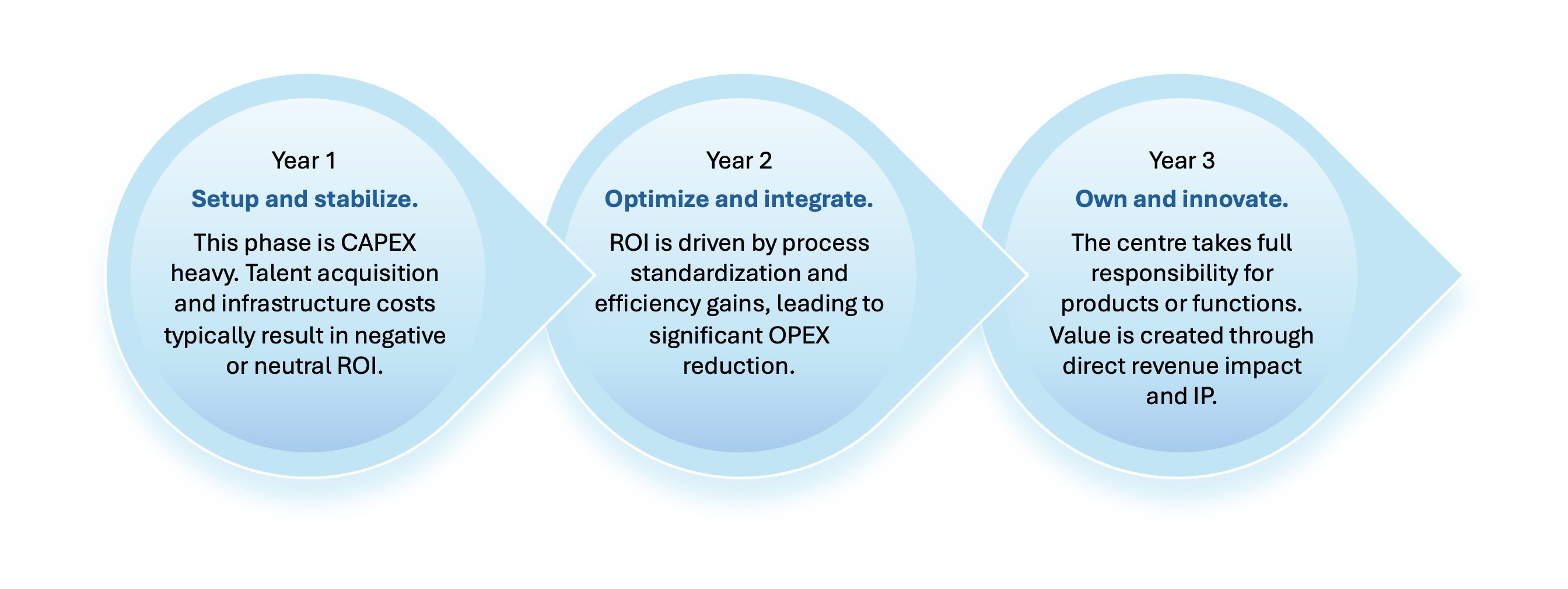
In Year 3, the GCC should generate its own economic value add. A centre still awaiting instructions from HQ at this stage indicates stagnant ROI.
Factoring in the AI Multiplier
An AI-neutral GCC is obsolete in current times. ROI calculators must account for Intelligence Arbitrage. Mature centres implement Agentic workflows where AI agents handle L1/L2 support or code documentation. This allows human talent to focus on high-value architecture, increasing the Revenue-per-Employee ratio. When a GCC functions as the AI Sandbox for the parent company, ROI often exceeds 2.5x. Successful leaders build GCCs as orchestration hubs and that’s where leadership matters.
The Hidden Variables
A robust ROI model quantifies preventative value.
Operational Resilience: A GCC provides a de-risked delivery network. The value is found in maintaining 99.9% uptime during regional crises in other geographies.
Talent Hedge: The GCC acts as a strategic hedge against visa constraints and domestic talent shortages in the West. The Cost of Vacancy at HQ often exceeds the total setup cost of a 50-person team in an emerging hub.
Building the Calculator
So, what is the total value of ownership? The executive narratives should be structured around a total value of ownership model using four pillars:
Direct Financials: Onshore versus GCC costs plus local tax incentives or government grants.
Productivity Gains: New output divided by old output, multiplied by revenue per unit.
Innovation Yield: Market value of generated IP and specific revenue from GCC-led products.
Strategic Option Value: The insurance value of immediate access to global talent and guaranteed business continuity.
Breakeven is a milestone, while the goal is a strategic long call option. Setup costs are a premium paid to access the hyper-scale innovation and talent. It defines a decade of competitive edge.
The era of the low-cost back office has ended. An ROI calculator puts forth the mandate provided to the centre. A mandate to own ensures ROI growth. A mandate to merely execute results in diminishing arbitrage.
What is your Total Value of Ownership (TVO) equation? Schedule a call and get a perspective from our experts.
Ready to build your scalable GCC?
Connect with our experts to discuss how we can help you establish and scale a high-performing Global Capability Center tailored to your business needs.
Recent Insights

Can a $100M–$1B Company Build a GCC in India? A Practical Guide
Can a $100M–$1B company build a GCC in India? Explore GCC costs, team size, setup timelines, compliance, and the build-operate-transfer model.
Sep 9, 2026
4 min read

Is your company too small for a GCC in India? (2026)
Not revenue, headcount. A captive works from 25 to 50 roles, phased entry from 10 to 30 people. Run the test and see where you land.
Sep 4, 2026
4 min read

BOT Model vs. GCCaaS: Best Way to Set Up a GCC in India (2026)
Compare the BOT model and GCCaaS for setting up a GCC in India in 2026. See how they differ on speed, ownership, cost and control, and which fits your entry plan.
Aug 24, 2026
4 min read