Accelerating Enterprise Value: The New GCC Operating Model for PE Leadership
4 min read

Private equity has built its return model on a simple sequence. Acquire the company. Improve it. Exit at a higher multiple. That sequence worked when holding periods were short and multiples expanded on their own. It works differently now.
Holding periods have stretched past six and a half years, the longest in twenty years. Exits are hard to time. Limited partners want cash back, not promises. Buying low and selling high doesn't work as well as it used to. Right now, buyers and sellers disagree on what companies are worth, so deals aren't closing at the pace, or price firms want.
They are holding companies longer, they have to make money the harder way, by practically improving how those companies run.
This is where the Global Capability Center (GCC) model enters the conversation, as an operating model.
The Business Case for GCCs in Private Equity
The case is simple to state. Every portfolio company competes on speed, cost, and access to talent. A GCC improves all three at once, and it does so in a way most other operating levers can't, because it works across the portfolio rather than inside a single company.
Speed improves because the center already understands the business. Instead of starting from a vendor briefing, it starts from context it has built over time.
A vendor has to be re-briefed on your systems, your priorities, and your quirks every time a new task comes in. A GCC doesn't. It carries that knowledge forward, deal after deal, so each new engagement starts further along than the last one did.
A GCC saves money differently. When the center standardizes a process, say, a finance workflow, and then rolls that same standardized process out to a second, third, and fourth portfolio company, the fund isn't paying to rebuild it each time. Each new company plugs into work that's already been done. So, the saving from that one investment keeps paying out across every future deal, rather than stopping after the first one.
Talent access improves because certain skills are simply easier to build offshore. Deep AI engineering benches. Round-the-clock operations coverage. Specialist finance and compliance capability at a price point that domestic hiring cannot match. This is more than cost benefit.
It requires a fund willing to treat the GCC as infrastructure, not as an experiment.
A story from the portfolio
Let’s say, a mid-market healthcare services company is recently acquired by a growth equity fund. The management team knows the business well. They know the market less well. Every new initiative gets routed through an external vendor, whether it is a claims platform or a compliance upgrade. Each vendor relationship takes months to negotiate. Each one starts from zero context.
Eighteen months into the hold, the fund realizes the transformation plan is behind schedule. Not because the strategy was wrong. Because the company never built the execution muscle to run it.
That gap between what the investment thesis promised and what the operating team could deliver defines the biggest risk PE firms carry today.
Now picture the same company with a captive Global Capability Center in Hyderabad. The center stands up a claims platform team. It builds a data analytics function. It runs the compliance operation. All under one roof, all reporting into the same leadership as the US business.
The center becomes an extension of the portfolio company itself, not a service sitting outside it.
That difference, between renting capability and owning it, defines why GCCs have become central to the PE playbook.
Why the old model cannot keep pace
Operating partners are expensive and stretched thin across too many portfolio companies. Consultants write reports and hand them over. They do not stay to execute. External vendors deliver output, but they carry no institutional memory of the fund's playbook from one deal to the next.
None of the mentioned models value add substantially to the business. A GCC does.
Every process it standardizes, every dashboard it builds, every benchmark it captures becomes reusable across the next acquisition. The fund stops relearning the same lessons deal after deal. It starts building an asset that gets smarter with scale.
That is the real argument for why PE firms need GCCs. Cost savings matter. A fund accountant costing sixty percent less in Hyderabad than in Boston is real money. But the deeper value sits in repeatability, in a captive center that remembers what worked at the last portfolio company and applies it faster at the next one.
Here’s a rough estimate for understanding the value quotient.
GCC cost advantage: 30-person team, annual cost (USD)
Cost category | India | United States |
Labor costs | $450,000 | $2,550,000 |
Real estate | $36,000 | $338,000 |
Overall savings | 40–60% lower | baseline |
(these are just estimated figures)
PE execution model: annual cost comparison
Model | Typical annual cost | Institutional memory across deals |
Operating partner (firms >$5B AUM) | $400,000+ base, before bonus and carry | Limited, tied to the individual |
External consultants | Project-based, no ongoing retainer | None, engagement ends at handoff |
GCC | Scales with team size, 40–60% below US cost | Compounds, reusable across every future deal |
(these are just estimated figures)
Three moments where the GCC changes the outcome
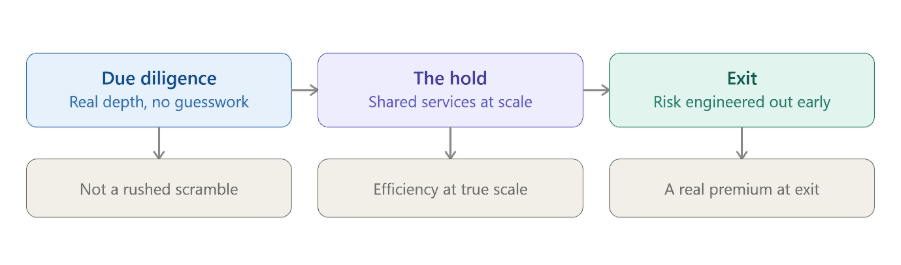
In due diligence, it brings real analytical depth instead of borrowed analysts working against the clock. Through the hold, it becomes the delivery engine, standing up shared services across portfolio companies and capturing efficiencies no single company could reach alone. At exit, it becomes the premium itself. A mature offshore model and a documented transformation record show buyers the operational risk has already been engineered out
Why India remains the reference point
The scale is hard to argue with. India now hosts more than two thousand capability centers, employing well over two million professionals. The market has moved past pure labour arbitrage into AI-native delivery, with a large share of centers already running agentic AI initiatives inside live business functions.
For PE firms, that shift matters more than it might first appear. A GCC built in this environment has access to a deep pool of AI and engineering talent that would take years and a much larger budget to assemble anywhere else.
A GCC that owns a product roadmap behaves differently from one that simply executes tickets handed down from headquarters. The same is true of a center that owns a compliance function end to end, or an AI strategy.
The 90-Day Time-to-Value Shift
The traditional objection to GCCs was time. Setting one up meant years of entity registration, real estate, hiring, and process transfer, long enough that most funds didn't bother for a single portfolio company. That objection is largely gone now.
Enablr has built pre-packaged GCC-as-a-Service models to reduce that timeline. Instead of building from scratch, a portfolio company plugs into an established playbook, entity structure, talent pipeline that has already performed in the past. This way, it goes live in under 90 days.
This changes the calculus. A multi-year build only pays off if the fund holds the company long enough to recover that setup cost, a harder bet with exit timing this uncertain. A 90-day build turns the question from ‘can we justify this over a long hold’ into ‘why wouldn't we do this at the start of every hold?’.
It also opens the model up to more than just flagship investments. A mid-sized company two years from exit still gets a payback window that works, so what was once reserved for a fund's largest bets becomes something every portfolio company can plug into on day one.
Our experts are just a call away to discuss your plans.
<section class="faq-section"> <div class="faq-inner"> <div class="faq-side fi v"> <div class="eyebrow">FAQs</div> <h2 class="sh2">Related questions</h2> <p class="sp"> Straight answers on how Global Capability Centers help private equity firms create value across portfolio companies. </p> <a href="/contact" class="btn-primary">Talk to Us →</a> </div> <div class="faq-list fi v"> <!-- FAQ 1 --> <div class="faq-item"> <div class="faq-q" onclick="toggleFaq(this)" aria-expanded="false" > <span class="faq-q-text"> What is a Global Capability Center (GCC) in private equity? </span> <span class="faq-toggle"> <svg viewBox="0 0 24 24"> <line x1="12" y1="5" x2="12" y2="19"></line> <line x1="5" y1="12" x2="19" y2="12"></line> </svg> </span> </div> <div class="faq-a"> <div class="faq-a-inner"> A GCC is an owned, offshore delivery center that a PE fund builds to support its portfolio companies with functions like finance, operations, engineering, and compliance. Unlike a vendor relationship, the fund controls the team, the processes, and the institutional knowledge, which lets that knowledge carry over from one portfolio company to the next. </div> </div> </div> <!-- FAQ 2 --> <div class="faq-item"> <div class="faq-q" onclick="toggleFaq(this)" aria-expanded="false" > <span class="faq-q-text"> How do GCCs help PE firms during longer holding periods? </span> <span class="faq-toggle"> <svg viewBox="0 0 24 24"> <line x1="12" y1="5" x2="12" y2="19"></line> <line x1="5" y1="12" x2="19" y2="12"></line> </svg> </span> </div> <div class="faq-a"> <div class="faq-a-inner"> With holding periods stretching past six and a half years, firms can no longer rely on buying low and selling high to drive returns. A GCC creates value during the hold itself by lowering costs and improving speed and talent access across the portfolio, so the business is measurably better by the time an exit becomes possible. </div> </div> </div> <!-- FAQ 3 --> <div class="faq-item"> <div class="faq-q" onclick="toggleFaq(this)" aria-expanded="false" > <span class="faq-q-text"> Is a GCC cheaper than outsourcing to a vendor? </span> <span class="faq-toggle"> <svg viewBox="0 0 24 24"> <line x1="12" y1="5" x2="12" y2="19"></line> <line x1="5" y1="12" x2="19" y2="12"></line> </svg> </span> </div> <div class="faq-a"> <div class="faq-a-inner"> Yes, over time. A vendor charges a margin on every engagement and has to be re-briefed on your business each time. A GCC is owned infrastructure, so the savings and the institutional knowledge compound as more portfolio companies plug into the same center, instead of resetting with every new task. </div> </div> </div> <!-- FAQ 4 --> <div class="faq-item"> <div class="faq-q" onclick="toggleFaq(this)" aria-expanded="false" > <span class="faq-q-text"> Which functions do PE-backed GCCs typically support? </span> <span class="faq-toggle"> <svg viewBox="0 0 24 24"> <line x1="12" y1="5" x2="12" y2="19"></line> <line x1="5" y1="12" x2="19" y2="12"></line> </svg> </span> </div> <div class="faq-a"> <div class="faq-a-inner"> Most GCCs start with finance, accounting, and compliance, then expand into engineering, AI, and round-the-clock operations coverage. The common thread is functions where offshore talent is either significantly cheaper or simply easier to find at the depth and scale a portfolio company needs. </div> </div> </div> <!-- FAQ 5 --> <div class="faq-item"> <div class="faq-q" onclick="toggleFaq(this)" aria-expanded="false" > <span class="faq-q-text"> When should a PE fund build a GCC instead of running pilots at individual portfolio companies? </span> <span class="faq-toggle"> <svg viewBox="0 0 24 24"> <line x1="12" y1="5" x2="12" y2="19"></line> <line x1="5" y1="12" x2="19" y2="12"></line> </svg> </span> </div> <div class="faq-a"> <div class="faq-a-inner"> Once a fund has more than two or three portfolio companies with overlapping operational needs, a shared center almost always outperforms one-off pilots. Pilots reset the learning curve each time, while a GCC treated as fund-level infrastructure keeps compounding in value with every company that joins it. </div> </div> </div> </div> </div> </section>
Ready to build your scalable GCC?
Connect with our experts to discuss how we can help you establish and scale a high-performing Global Capability Center tailored to your business needs.
Recent Insights

What Is the Minimum Viable Team Size for a GCC?
A standalone captive GCC becomes economically sound at roughly 25 to 50 engineers.
Sep 11, 2026
4 min read

Can a $100M–$1B Company Build a GCC in India? A Practical Guide
Can a $100M–$1B company build a GCC in India? Explore GCC costs, team size, setup timelines, compliance, and the build-operate-transfer model.
Sep 9, 2026
4 min read

Is your company too small for a GCC in India? (2026)
Not revenue, headcount. A captive works from 25 to 50 roles, phased entry from 10 to 30 people. Run the test and see where you land.
Sep 4, 2026
4 min read